Saturday, March 24, 2012
On stage- feeling animated, enchanted and just right
WHEN I go and watch a musical, I always wonder how props are moved around with such ease, how a staircase can just appear from nowhere and how dancers tango in perfect symmetry. Sometimes I wonder, too, why the legendary Phantom of the Opera insists on his Box Five, how the Man of La Mancha is performed on a single set that suggests a dungeon or when the eyes of the camels in Joseph's Technicolour Dream Coat will move when you least expect them to.
I know now because I am on the other side of the performance hall: not sitting down and watching a musical but on the stage and being part of the cast, albeit a smallish role.
When the Nenagh Choral Society put up a notice last year in a local tabloid called The Guardian inviting interested amateurs to join the musical production of Beauty and the Beast, I knew I must give it a try.
I had watched the Disney movie countless times when my three children were young. We used to dance and sing in front of the television imitating the antics of Mrs Potts the teapot, Lumiere the Candlestick or Cogsworth the clock. So to actually be part of the cast, I asked myself, "Why not?"
The last time I performed before an audience was when a group of us staged a play at the Experimental Theatre in Kuala Lumpur. It was hard work but great fun. So I rallied my daughter to join me in this new adventure, although it meant driving miles on cold windy nights for practice, practice and more practice. We had each other for company and we knew we would enjoy being animated objects in the enchanted castle.
As with every endeavour, I braced myself for new experiences.
Under the wings of dedicated director Greg Browne and committed music director Laura Kearney, we learnt to sing and dance in harmony. I was practically singing or humming the songs during my waking hours and possibly in my dreams as well. The best part was the more we sang, the more confident we became.
Staging a good production comes with a cost. Costumes had to be made or rented. For instance, in the opening act, we are at a French market place complete with baguettes and bonjour. And for the enchanted castle act, we are transformed into knives, plates, napkins, wardrobe, teapots and such.
The fund-raising projects were varied and I took part in the packing of groceries for customers at the check-out counter of a local supermarket. This was something novel to me as supermarkets in Malaysia have a ready pool of salaried staff to do that for the customers.
The customers would hand me their shopping bags (plastic bags are bad for the environment) and I would put in their groceries. As with most innate organisational skills, I separated food items from non-food items. Then I separated the food items accordingly (wet and dry produce) and packed them. One of the customers said, 'I would have done exactly the same. Thanks a million' and dropped a generous contribution into the collection bucket.
The next challenge was, of course, making friends, which is never easy, especially when you are new to any group. I appreciate Francis Burke, who opened the door with a smile to the school hall for every one of our practices, and Majella Keogh, who coached us in our dance steps. Then there are Bernie and Margaret McGee, who make me feel at home with the crowd, Billy McNamara, my charming animated 'salt and pepper' partner, Alan O'Brien, the versatile and talented actor and singer, Jimmy McCarthy, who gracefully waltzes with me, and many others, too.
Needless to say, the greatest challenge was that of commitment and punctuality. Private agendas had to make way for the musical. This was especially crucial during the weeks leading up to the opening show. Being part of a team meant that if you were absent or late, the whole team would be affected.
Today is our second performance and we have six more to go before March runs out. It seems as if the stars are in alignment and everything is just right. I do not feel the passing of time, but only of the moment which leaves a good feeling within.
Absolutely no regrets.
Source: http://www.nst.com.my/opinion/columnist/on-stage-feeling-animated-enchanted-and-just-right-1.65703
Saturday, March 10, 2012
A Circle of Friends
I HAVE just befriended Sarita Bergess and I am amazed. A beautiful lady with a gentle spirit, she makes doll houses as a hobby. I stand corrected; not just doll houses but lots of other crafty stuff as well like stained glass, wickerwork, pottery and wooden figures.
As I have never had a doll house before there was a certain thrill seeing the miniature chandeliers light up to show the beds complete with duvets, the intricate miniscule furniture, that tiny sewing machine and the floral wallpaper so carefully coordinated as if to ensure that the little individuals that live within have a place where they can be happy.
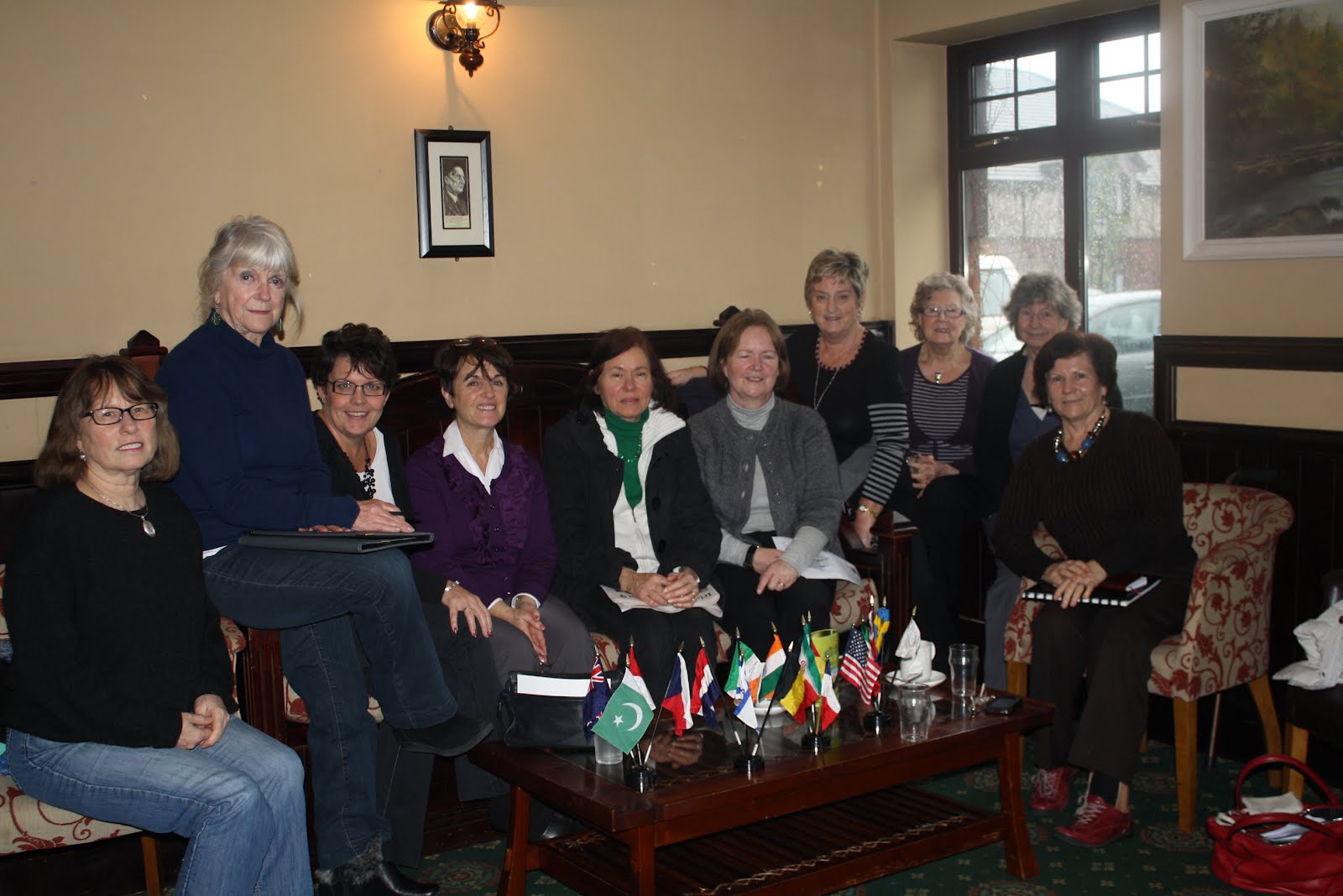
Sarita and I are both members of the International Women's Organisation (IWO) in Limerick. This unique club for women of all ages and nationalities was founded in 1980. We meet regularly for fun stuff like trips to movies and concerts. We meet to chat about the serious and the trivial. We meet to sip the aromatic freshly ground coffee and to savour the guilt-laden rich chocolate cake.
There are all sorts of clubs that you can go for, but to actually find one that you are comfortable with is something else. Then there is this fear that you may annoy someone because of the subtle differences of language and meaning. What we mean well in our culture may be totally misconstrued in another. When we joke, comment or spar with the locals we may be mistaken for attacking the host culture and the worst scenario is when the person becomes very defensive of what he is familiar with.
So in a way, the IWO is unique because against an international backdrop, there is much intercultural give and take. It is some sort of a neutral ground where we feel safe to speak, to laugh or to cry.
The gathering instinct appears to be primal. Prehistoric women gathered seeds and grain for the table. So it is not surprising to see a need for women to gather together for friendship and support.
When we were in school, we wanted at least a "best friend" -- someone who shared our dreams and our interests. We would go everywhere together and even dress in similar fashion. Remember the "Sisterhood of the Travelling Pants" where four best girlfriends hatch a plan to stay connected with one another as their lives start off in different directions by circulating a pair of second hand jeans that fits each of their bodies perfectly? Something like that.
But as we grew, the chances of not remaining best friends became very real and we separated because of distance, education, level of maturity or a conflict of interests.
Then like a spider trying to repair a torn web, we would search for another friend to fill the aching void. Well and good if the new best friend emerges. If she is not to be found, we continue searching.
Whether by choice or by design we have made Ireland our second home.
Most of us have left our friends and families behind and it takes a lot of resolve to start all over. We try new approaches and put ourselves in all the right places. However, conversations seem to stop at "'how ya?" and "the weather's grand today".
Although we believe ourselves to be interesting, loyal, kind, and friendly, we still have a difficult time breaking into the cliques that have existed since time immemorial. To prove this point, someone in a local sewing group which I attend said that it is "a wonder" how I returned to the group every week to sew. No other "visitor" had survived.
It is not uncommon to end up feeling like a fly on the wall when others engage in their own "craic" and think that Malaysia is in Africa. A staff called Seamus in the butcher and fish section of the local Supervalu supermarket made small talk with me the other day over the counter. He was genuinely interested in where I was from and I thought that was nice. Most times I would have to wait for other staff to finish their conversations with their customers at the post office or bank or any grocery store. And it could be a good number of minutes regardless of how long the queue is.
So back to the doll house.
In many ways, we want to be in a place where there is order. We want to be in a place where we are happy. Most of all we want to be in a place where we have friends.
Source: A Circle of Friends - Columnist - New Straits Times
http://www.nst.com.my/opinion/columnist/a-circle-of-friends-1.58752#ixzz1on8e3Vfg
Saturday, February 25, 2012
THE ECONOMICS OF LIFE
An excerpt from the book ‘Dumbing Down our Kids’ by educator Charles Sykes lists 14 things young people did not and will not learn in school. Bill Gates also mentioned them in his speech at a High School. I personally like rules 3, 5 and 7:
Rule 3 : You will NOT make $60,000 a year right out of high school. You won't be a vice-president with a car phone until you earn both.
Rule 5 : Flipping burgers is not beneath your dignity. Your Grandparents had a different word for burger flipping: they called it opportunity.
Rule 7: Before you were born, your parents weren't as boring as they are now. They got that way from paying your bills, cleaning your clothes and listening to you talk about how cool you thought you were. So before you save the rain forest from the parasites of your parent's generation, try delousing the closet in your own room.
The underlying thread is perhaps the importance of the economics of life targeted at a generation that has no concept of reality and expects hand-outs and bail outs from doting parents and the like.
Quite recently my step sons gave me a beautiful porcelain money box and I took a trip down memory lane and remembered three specific events.
At seven years old, I had my first ceramic money box in the shape of an animal and I began to stash away a tidy sum of unused pocket money.
One day when my mother and sister were leaving for Kuala Lumpur for an event which I cannot remember now, I excitedly asked my sister to get me a teddy bear if she saw one. I had seen teddy bears in books but never had one. The one that I fancied was the Made-in-China one which had bright orange fur and moveable arms. When my mother and sister returned from Kuala Lumpur, I was overjoyed when the very same bear was thrust into my hands.
But the joy was short-lived as my mother quipped, ‘Now who is going to pay for that?’
I knew from the severity of her voice that there was no two ways about it. So I went to my money box, removed the rubber stopper and counted RM21.00 in coins. The bear cost RM13. Much as I loved the bear it was heart rending to have to part with that huge amount of money that had been saved over a long time. So I handed the money to my sister who had paid for it only to be told that she and my brother had split the cost of the bear and I did not have to pay anything for it. Not only did I have the bear but my savings were also intact. That was the ultimate child’s dream.
At eight years old, I had eyed a pair of Shirley Temple’s Mary Jane at a BATA shoe shop. A stipend of RM6 was given for pair of new shoes each year and if I wanted anything fancy, it was understood that I had to pay the difference in price. I paid the difference of RM7.
I am glad that I learnt the value of money and economics.
At nine years old, I learnt the meaning of disciplined giving. The Christian faith teaches that the believer tithes one-tenth of what he has. So I acquired a second money box in the shape of a plastic shoe. Only this time there was no rubber stopper at the sole of the shoe.
For every ringgit I had I put away ten sen into the money box. When December came, I gave the shoe to my sister and asked her to take it to the church because my mother did not allow me to go to church then as she was not a Christian at that time. The money was to be given to the missionaries and to the children in faraway lands who needed it more that I.
I had read in a book where some children had to wait a whole day for a benevolent person to give them a cucumber to ease their hunger pangs. I had read another story where a mother had to put rubber bands round a milk bottle to serve as markings so her three children knew exactly how much milk each was entitled to.I felt great joy handling over that shoe that was very laden with coins.
Needless to say, when I studied economics in Form 6, it was like a familiar friend. When I taught economics in Kluang High School, I enjoyed it thoroughly.
Source: http://www.nst.com.my/opinion/columnist/the-economics-of-life-1.51928
Sunday, February 12, 2012
GUESS WHO IS COMING TO DINNER?
IN Guess who’s coming to Dinner, a 1967 American drama film starring Spencer Tracy, Sidney Poitier and Katharine Hepburn, we see a young white woman bringing home her new fiancĂ©, a black physician, to meet her parents.
Now, fast forward to 2012 and you find your daughter bringing home to dinner a man whom she fancies except that he is of a different race.
What will your reaction be?
Will it be very different from that of Matt (Spencer Tracy) and Christina Drayton’s (Katharine Hepburn)?
In Malaysia, we do have many mixed marriages and most parents have braced themselves sufficiently for love relationships between Malays, Chinese, Indians, Eurasians and Caucasians.
But the feedback I got was despite the modernity of this day and age, most Malaysian parents are still not very comfortable with the idea of the fusion of colours on the opposite extremes of the colour spectrum: black and white.
Good friends yes, but to go further than that is a different matter. This reminds me of what Christina Drayton said in the movie:
“She’s 23 years old, and the way she is, is just exactly the way we brought her up to be.
“We answered her questions. She listened to our answers.
“We told her it was wrong to believe that the white people were somehow essentially superior to the black people, or the brown or the red or the yellow ones, for that matter.
“People who thought that way were wrong to think that way. Sometimes hateful, usually stupid, but always, always wrong.
“That’s what we said. And when we said it, we did not add, ‘But don’t ever fall in love with a coloured man’.”
I am all for cross-cultural education and appreciation.
When I was lecturing or presenting papers at conferences, I enjoyed wearing the kebaya, cheongsam or sari to reflect the multi-ethnic diversity of Malaysians.
When I hosted dinners, the menu would be an assortment of dishes from different cultures.
During my travels, I would be very interested in the country’s cultures, traditions and cuisine.
For instance, from Nepal, I learnt how to wear a Daura-Suruwal, which is a traditional Nepali dress; from China, I experienced the “fire cupping” for the tired traveller’s body and from Cambodia, I learnt how to cook a popular Khmer dish called Amok trey which is fish covered with kroeung (a marinade paste) and coconut milk, wrapped in banana leaves and steamed.
When we are exposed to others quite unlike ourselves, we learn a great deal.
Basically, aspirations and needs are relatively similar despite the skin colour.
There are universal values like taking care of our health, being considerate and mindful of others and being polite.
There are also common threads in bringing up children, in the importance of education and in the pursuit of dreams.
However, there are also obvious differences in the way we perceive what happens around us and good taste in one culture may not be the same in another.
Having said that, differences may blur over time and boundaries that once existed between cultures in one generation may not be there in the next generation.
I like the phrase “To separate the chaff from the wheat” which means to separate things of value from things of no value.
What are the things that we look for in a person?
Some girls look for the 5 Cs when choosing their future spouses — Cash, Car, Credit card, Condominium and Country club membership.
Others look for physical attributes. In the choice of a mate, my advice to my children has always been value-based: God-fearing, responsible, sensible, diligent and true.
So the acid test presented itself when my five-foot-three (1.6m) daughter brought home a six-foot-five (1.9m) male specimen for dinner.
The coffee coloured God-fearing, responsible, sensible, diligent and true Sudanese guest and the yellow coloured Malaysian daughter offered to prepare the dessert — an orange coloured carrot cake with cream coloured cheese frosting in my white Irish kitchen.
Now, that is what I call a colourful setting.
I could not agree more with what Matt Drayton said, “There’ll be 100 million people right here in this country who will be shocked and offended and appalled and the two of you will just have to ride that out....... But you’re two wonderful people who happened to fall in love and happened to have a pigmentation problem….”
Happy Valentine’s Day
SOURCE: Guess who’s coming to dinner? - Columnist - New Straits Timeshttp://www.nst.com.my/opinion/columnist/guess-who-s-coming-to-dinner-1.45449#ixzz1m9zgCQdE
Tuesday, January 31, 2012
A HOME AWAY FROM HOME
If anyone asks me to name a place for tourists where people are helpful, and friendly and live side by side in a multicultural pot filled with delightful flavours, I would definitely say Malaysia without blinking an eyelid. That is why I was so surprised to discover another place on the other side of the globe that has practically all the characteristics that I mentioned above: Boston.
We went there recently on a vacation and when we were trying to make sense of the Massachusetts Bay Transportation Authority (MBTA), the person manning the information booth literally jumped out of the booth to give us very clear instructions. A big burly man towering over us explained: ‘You can take the B, C or D train to Kenmore but never the E’. This he repeated himself slowly, patiently and definitely -the way felt puppet television characters would tell lost denizens. I was impressed. Most times, we would have to speak through a perforated screen to the very important information officer sitting secure in a booth or worse face the words ‘No Information’ boldly printed on the glass pane as observed in some booths in Rome.
The MBTA was very convenient and efficient and every time I looked around, I felt very much at home. I would see Hispanics, Chinese Americans, Koreans, Japanese, Mainland Chinese and a good blend of other ethnic groups. The best part was everyone spoke English according to his own accent, and everybody understood each other which goes to prove that people from a more culturally and ethnically diverse city are more in-tune with different accents and are thus able to make meaning of what they hear. Unlike in some countries where I had to repeat myself or speak slower, I had no problem whatsoever communicating with Boston folks.
When we walked along the street with a map we had strangers come up to us to readily point out to us where we wanted to go, be it on the historical trail or to go downtown to shop. To quote an example, we wanted to go for the Boston Ballet Nutcracker and were heading towards the box office. Suddenly a sweet elderly lady sprung up at the traffic lights and informed us that we could get half price tickets if we were to purchase from the Bostik Booth instead, just because we were pouring over a map as the lights turned red.
Then there was the food factor.
Feeling hungry, I picked up the scent of a mobile Asian Bistro (parked on the Massachusetts Institute of Technology’s campus grounds) that was busy selling packed lunches to hungry students and visitors. Making a bee-line to the van, I smiled when I saw the menu that offered Teriyaki fish, Pad Thai noodles, Vietnamese spring rolls, Penang Curry Laksa and Beef Ramen with free hot tea thrown in. That reminded me of the ‘economy rice with free hot tea’ meals that I used to eat when I was an undergraduate, living in a rented room in Section 17, Petaling Jaya.
In shopping malls, the food corners boast of a great variety of food: deep-fried, steamed, stir-fried, poached, barbequed, curried, roasted, blanched and battered. The city’s Chinatown which is the third largest after New York and San Francisco displayed mouth watering roasted ducks, teochew ducks or steamed chicken with their skins gleaming under the spotlights in the glass show cases. I could even smell the goodness through the glass. For a moment, I thought I was not very far from Petaling Street.
Boston is also home to educating the mind.
24 hour television programmes served my jet lag hours and my personal favourite was Sesame Street which was aired without fail in the wee hours of the morning. Most of the characters have remained the same except that Ernie and Bert now take the form of computer-generated imagery and sport dread locks instead of the familiar tufts of hair. A visit to the Harvard University left me even more convinced that there could never be an end to learning.
What is beautiful about Boston and the life it exudes is that it is a wonderful combination of the old and the new, of the puritan and the liberal, of painful memories and eventual independence, of singularity in mindset but plurality in outlook, of tradition and of change.
I thought it was just like home.
Source: The New Straits Times http://www.nst.com.my/opinion/columnist/a-home-away-from-home-1.38662imes,
Sunday, January 15, 2012
Keeping Alive Our Traditions
I find monasteries fascinating. My first exposure to a monk was via the character of the Friar Tuck, the jovial friar and one of Robin Hood's Merry Men. Who could forget the infamous Friar Tuck’s haircut?
When I first went to the Cistercian Abbey in 2008, I stood amazed at the beautiful building that stood out like a gentle giant against the bucolic setting. I had great fun trying to approach some grazing sheep. The closer I got to them, the further away they ran from me.
Nothing could be more pleasant than to have hot tea and scones in the Abbey’s cafĂ©. Each table had chairs that were different. At first I thought it was strange but then I began to fall in love with the creativity and the contrast. While the monks were all dressed in robes, there was absolutely no uniformity in the colour or shape of the chairs. All this made the tea and scones even more delicious.
So, when I had the chance to visit the Cistercian Abbey again recently, I knew I would be fascinated once more. But this time it was to watch Fiddler on the Roof, an annual production by the boys of the Cistercian College that is within the Abbey.
Fiddler on the Roof is a musical set in Tsarist Russia in 1905. The story centres on Tevye, the father of five daughters, and his attempts to keep his family and traditions together.
Whether it is in 1905 or 2012, keeping a family and traditions together is still a feat.
Even with big families in Malaysia, it is not uncommon that when the matriarch or patriarch passes on, sadly the family also breaks up. It takes concerted effort for brothers and sisters to link up and reasons for not doing so abound: geographical distance, family feuds and private concerns. If anything, the unassuming email loop is one way to keep the embers of kinship glowing.
Some traditions are good. I am happy to say that Malaysians still observe many admirable traditions. But not all traditions are helpful and we should learn to let them go and embrace new things and change.
In the musical there is this recurrent theme of arranged marriages (tradition) versus love marriages. (new) In an arranged marriage, great care is taken to ensure that the bride and groom are compatible. Important issues to consider are similarities in religion, culture, background, family status or academic standing. However, whether it is an arranged marriage or a marriage based on love, there is no surety that it will be happy. The only surety is that the parent’s heart will go all soft when the child walks down the aisle. This is beautifully captured in the lyrics of the song ‘Sunrise, Sunset’ where Tevye asks, ‘Is this the little girl I carried? Is this the little boy at play? I don’t remember growing older, when did they?’
Wedding traditions too are symbolic and meaningful. Like the tea ceremony in a Chinese wedding where we show our respect to the members of our new family. I remember carefully bringing the porcelain tea set over to Ireland and serving tea to my late mother-in-law to show her that I loved her as my own.
Call it Malaysian tradition, culture or customs but upholding what is meaningful, ethical and good is never easy.
The tradition where children, even at a young age are taught their proper place and responsibility within the family. The tradition of respecting people in authority especially teachers and not answering back or challenging them. The tradition of greeting our elders at the dining table before eating. The tradition of serving our elders first before we eat. The tradition of hospitality and sharing our food with siblings and friends and even acquaintances. The tradition of working hard in our youth and taking care of our parents when they are old. The tradition of taking off our shoes before we enter the house.
Finally, the tradition of family members coming together on the eve of the Chinese New Year for a reunion dinner. To me that encapsulates the spirit of solidarity, love and unity. And that is what I miss when we are oceans apart.
A Happy Chinese New Year to all ……….
Source: Keeping Alive Our Traditions, www.nst.com.my
Saturday, December 31, 2011
Kissing the Blarney Stone for Eloquence
According to wikipedia, eloquence (from Latin eloquentia) is fluent, forcible, elegant or persuasive speaking. It is the ability to express strong emotions appropriately and it is being able to write fluently as well. This is the magic that politicians seek after, debaters battle over and orators die for.
We have seen impeccably groomed people who when they open their mouths, sound very common. In contrast, there are those who will sweep you off the feet the moment they say something. The trick it seems is to talk slowly and deliberately. When a speech is rushed, there is poor control of what is said, resulting in what some call ‘verbal diarrhoea’. For speakers of English as a second language, added problems are first language interference, incorrect pronunciation of words, inaccurate intonation and wrong placement of stresses. Most times students are not taught phonetics nor are they exposed to native speakers.
Having been to a number of one-act plays, I marvel at the eloquence the actors possess on stage. It is amazing how there can only be one person on stage delivering a monologue and yet the audience is not bored. It is the strength and clarity of the voice that say it all.
Some say eloquence is one-third content and two-thirds presentation. Others say it is a craft that can be developed through practice, apprenticeship and coaching.
One fine example was J.F. Kennedy in his series of televised debates with Nixon. His style was eclectic: it was skeptical, laconic, careless and purposeful. Peppered with wit and aptly chosen words, he became the youngest man in American history to win the presidency.
Yet, there are always short cuts for those who do not have the time to practise, Irish folklore says ‘there is a stone that whoever kisses never misses to grow eloquent, he may clamber to a lady’s chamber or become a Member of Parliament.’
That is none other than the infamous Blarney Stone.
The Blarney Stone is a block of bluestone built into the battlements of Blarney Castle, Blarney, about 8 kilometres from Cork, Ireland.
One of the stories associated with this stone is associated with the Lord of Blarney, Cormac McCarthy who saved an old woman from drowning sometime in the 14th century. In gratitude the old woman cast a spell on the stone so that the Lord would never again be at a loss for words.
It is not surprising therefore that visitors from near and far make a pilgrimage to lock lips with the stone. This includes statesmen like Winston Churchill, hollywood actors, famous novelists and playwrights. In the episode entitled ‘In the Name of the Grandfather, Homer and grandpa Abe Simpson visited the Blarney Castle. Even singers kiss the stone, Mick Jagger included.
So deciding to follow the footsteps of the famous who must have benefited from this swift puckering of lips, I made a beeline to seek out this enchanted stone once and for all. Besides promising myself that it would be great fun, my line of reasoning was if these people are still the icons of the day, then the Blarney Stone could have contributed to it.
Now, kissing the Blarney Stone is no mean feat and the trick is to kiss the stone in a certain way in order to tap its full power.
First you have to pay a fee to enter the Blarney Castle and then ascend to the top. The stone dramatically is set on the top storey. Then you will need to lie down away from the stone and grasp the railing firmly with your hands above your head. There will be people who will help you lean backward so that your head is even with the stone in order for you to kiss it. Once the kiss is rendered, viola, your photo is professionally taken. For those who suffer from acrophobia, there is a virtual Blarney Stone. (http://www.irelandseye.com/blarney/blarn....) but I cannot promise that the effect will be the same.
Was it worth the effort climbing to the top of the castle in the Irish drizzle so I can be part of the 200,000 hopefuls who perform the sacred act annually? Could the cold arrest the multiplication of germs on that particular part of the stone that has been kissed? Have I received the ‘gift of the gab’ to welcome 2012?
Shortly after my return from the castle, I complimented someone with some well-meaning remarks of admiration.
He said, ‘I don’t think you have kissed the Blarney Stone. You must have swallowed the whole stone even.’
Talk about an instant eloquence enhancer.
Wishing everyone a Happy New Year!
Read more: www.nst.com.my/opinion/columnist/kissing-the-blarney-stone-for-eloquence-1.26159
Subscribe to:
Posts (Atom)