Showing posts with label BOOKS. Show all posts

Friday, December 13, 2019

WALKING DOWN NOSTALGIC BOULEVARD

It is very strange when lovely images of our childhood pop up when we least expect it. How long these images have been locked in the recesses of my brain amazes me. The best part is I can always check with my siblings regarding the authenticity of such memories as more often than not we share the same memories.

What is childhood without books?

When Mike showed me the youtube video of Paul McCartney's The Frog Chorus, I was over the moon. Then suddenly, amidst the frogs croaking there was Rupert the Bear appearing from behind the foliage. This is one bear that I'm all too familiar with.


My brother had an Annual and I used to pore over it with delight. There was this scene where Rupert and his younger visiting cousin (I think) were standing under a soursop tree. And the little one took a bite of a ripe soursop and said it was sour! I laughed because obviously the writer must not have tasted a ripe soursop because it is the most glorious and sweetest fruit ever! I was only 6 then and already engaged in critical analysis.

Another wondrous book that he had was the Story of Little Black Sambo who went into the forest in his Sunday best only to be accosted by 4 angry tigers.


 Finally in an effort to ditch them Sambo climbed up a tree. The four tigers chased each other around the tree. The midday heat was simply unbearable so the tigers melted and became tiger butter. That is hilarious!


So Sambo's mother Mumbo collected the butter and made pancakes. The pancakes were most delicious and Jumbo (Sambo's father), Mumbo and Sambo tucked in happily with Sambo eating the most. (mumbo jumbo - political correctness was virtually absent then)

So imagine my delight when I found fudge at the Galway Christmas market that is named tiger butter fudge!

The next category of good memories is food. Malaysians generally love food and get very creative over food. In fact, we often go for long drives just to taste some special cuisine. We not only love food, we love to cook too.

When it is cold outside, I feel peckish. So I think of food. Not any type of food but food connected with certain occasions. Who can forget yesteryear's Quality Street Sweets?


And when our father brought us to the cinema he would buy us a packet of Peanut treets. We could also choose the cut fruits that were displayed on a block of ice. Ivory coloured apple or pear halves, sometimes oxidised at the edges. Each piece of fruit had a toothpick jabbed into it.


 Then when we were sick, we would get a special treat. Mum would buy us golden puffs or Bluebird chocolate toffee and that really aided recovery and brought such comfort to the sorry soul.


I guess the memory that captivates me most is the prized turkey or was it the goose? I can't remember. Anyway someone gave us a big fowl, as big as the one in the window in Mr Scrooge's village. We had no oven then, so we brought the fowl to the local restaurateur and he agreed to roast it for us. After 4 hours, a few of us sisters walked down to the restaurant to collect the turkey. It wasn't quite ready yet but what a sight! It was a huge brick oven with an open fire and the chef was generously basting it  with rich thick sauce. The aroma was like heaven and that was how I remembered the whole episode.

It's funny how different present day cookie tins or food tastes like. I'm glad that I'm ancient enough to have enjoyed what is vintage and what is now.


Saturday, July 22, 2017

PADDINGTON BEAR'S CREATOR LEAVES A LEGACY OF LOVE


I have a number of favourite writers and poets and sometimes I forget that they, like myself, are only human and that they do not live forever. Frank McCourt, Maeve Binchy, Elie Wiesel and Seamus Heaney. And lately Michael Bond who died at age 91 about a month ago on 27 June.

Michael who? Michael Bond, the creator of the marmalade loving Paddington Bear.  


I have unashamedly amassed a number of Paddington paraphernalia – an umbrella, a key holder, buttons, washi tape and an 18 inch bear complete with his signature duffle coat and wellies.  I saw the Paddington movie three times, (once on the big screen and twice over the television) because of the bear and because of Hugh Bonneville, who plays Mr Brown. When I went with my friends to see the movie, I brought along little tubs of marmalade for everyone, just to be in solidarity with the bear.


I even made a special trip to Paddington station. I was secretly hoping to see Paddington sitting on a small suitcase near the lost property office, wearing a hat.  I felt how the bear felt – lost - when he first arrived as a stowaway, sent by his Aunt Lucy who has gone to live in the Home for Retired Bears in Lima.  I could not resist standing beside the little statue of Paddington Bear at the station.

What makes Michael Bond’s creation so endearing?

Basically it is the connection.

When we attend a social event it is inevitable that we need to mingle. Imagine talking to a group of people who bore your socks off. The first reaction is to wish that the event will end quickly and you can go home. The same goes with the characters in a book – you either love them or hate them.

So I connect with Paddington.

He is honest and kind and has very good manners. It is hard not to love someone with good manners, even more so a bear!

It is also the sorry feeling for an unwanted toy. Michael Bond was searching for a gift for his wife on Christmas eve in 1956 when he came across a teddy bear all alone on a shelf. Clearly he was a last minute shopper and he ‘adopted’ Paddington. That was the humble beginnings of a famous bear.

Paddington came from a different land. Originally Bond wanted him to come from darkest Africa but he was informed by his agent that Africa does not have bears. The bear was a refugee seeking a new home on foreign soil. Because of his cross cultural background, Paddington was chosen in 1994, by English tunnellers as the first item to pass through the Channel Tunnel to their French counterparts when the two sides were linked up. There are over 35 million copies of Paddington books sold worldwide which have been translated into 40 languages. This bear has inspired pop bands, race horses, plays, hot air balloons, a television series and a movie.


According to Bond, Paddington’s universal appeal is due to the ‘Paddington-type situations’ that happen all over the world – the fun times and the mishaps.

I was first introduced to wellies by Paddington. There was no need for me to wear wellies in the city where I was born but I knew about them because of Paddington. Now I have three pairs of wellies of different designs and heights and I can identify with the bear when I trudge into puddles, mud and bog.

Then there is this label around Paddinton’s neck when he first arrived in London which read: ‘Please look after this bear.’ It reminds me of a visit to a school in 1970. It was Chefoo School in Brinchang in Cameron Highlands which functioned as a school for the children of missionaries and the curriculum was based on the British education system. The children were away on holidays at that time and on one of the bunk beds I saw a well-cuddled bear with the same label on its neck. That stopped me in my tracks and I wondered how the child would have felt living in a residential school and also having to leave her favourite toy behind when she went home for the holidays.

Bond’s first book was published in 1958 and his last in 2017, a span of 59 years. The next Paddington movie will be released at the end of this year. On the last day of the shooting, Michael Bond passed away. He left behind legions of fans, his family, his guinea pigs and most of all the much loved bear

from darkest Peru.

THIS ARTICLE WAS ORIGINALLY PRINTED IN THE NEW STRAITS TIMES MALAYSIA 
23 JULY 2017
https://www.nst.com.my/opinion/columnists/2017/07/259876/paddington-bears-creator-leaves-legacy-love


Saturday, November 12, 2016

CHANGING INTERESTS

I like the word proclivity. I don’t hear it often enough but it explains so many things all at once. According to the Merriam-Webster thesaurus, it is synonymous with affection, affinity, aptitude, bent, bias, disposition, leaning, partiality, penchant, inclination, and tendency.


I used to be able to read anytime, anywhere. Not any more. When I bring a book with me to bed, I only manage to finish a few pages before my fingers reach out for the bedside lamp and I float off to dreamland. This routine is repeated the next night, the only difference being I would have forgotten who is who in the book, how they are related and why they are all gathered in the country manor house in the first place. Re-reading to find the connections is arduous.

I thought that with retirement I would be able to read War and Peace, cover to cover, several times over. How strange that getting past the daily newspaper or the occasional magazine has become a great achievement.

I am surrounded by a reading culture. The library is nearby and the helpful librarian will bring in the books that I request if they are not on the shelves. The charity shops and flea markets are overflowing with pre-loved books.

As a child I would re-read my favourite books. So recently, I purposed myself to set aside every Sunday to read a novel before I miss all the good stuff that is trapped between the pages. It is the chance to reclaim something pleasurable.

Firstly I re-visited Roald Dahl’s books. 2016 marks 100 years since the birth of the story teller. Running though his books are the themes of loneliness, abuse, friendship and kindness. The child in me identifies with the unlikely hero or heroine. My favourite is Matilda.

But what next?

I find that my interest in fiction has waned. I’m no longer captivated by plots of mystery or love. I tear through best sellers and they have come up short. In fact the first ten pages can tell you how the book will end and how the characters are all related. There is a lack of originality in the themes.  There is a lack of depth as sense that these writers are trying to squeeze in too many modern day concerns between the covers. These modern day popular writers are a poor comparison to yesteryear’s Charles Dickens or the Bronte sisters.

So I’m more attracted to non-fiction particularly memoirs, culture and history.

My latest favourite is Elie Wiesel’s Night. All 116 pages of it.


The same can be said of television programmes. Gone are the days when I would wait for serial episodes and the like. Now I mainly record documentaries or travel pieces and watch them at my leisure, fast-forwarding all the advertisements in between. As for movies, nothing beats the big screen whether it is Disney’s Polynesian princess Moana carving out her adventure trail in 3 D or Tom Hanks following a trail of clues connected to Dante.

Even the taste for food differs. Sweets and chocolates used to entice me as a teen but now I prefer anything home-cooked and the more authentic the recipe the better. I re-discovered an old recipe that I had written down for savoury pumpkin cake where ingredients were measured in katis and tahils! Needless to say, I quickly harvested the pumpkins from my garden. I never understood why my mother liked the miserable looking bittergourd either but now I can snack through crispy bittergourd fries (pavakkai varuval) with relish!


My taste for clothes too changes with the seasons. Wouldn’t it be nice to have four wardrobes, one for each season?

With time, our proclivities and prerogatives change and I’m ok with that.

THIS ARTICLE WAS ORIGINALLY PUBLISHED IN THE NEW STRAITS TIMES, MALAYSIA
13 NOVEMBER 2016

http://digital.nstp.com.my/nst/books/nstnews/2016/20161113nstnews/index.html#/23/


Saturday, November 15, 2014

Wearing My Heart on My Sleeve


With Michael Harding as he autographed his first book, Staring at Lakes

I love to read. Correction – I love to read books that are engaging. Not too short that all the significant bits are glossed over and not too long where after arriving at page 459, the end is no where near, and I have forgotten who is who in the plot. Certainly at this time of my life I am not going to read a book because I have to (as in book clubs and reading lists) but because I want to.

So having heard the news that ‘Hanging with the Elephant’ by Michael Harding has hit the bookshops, I rushed down to Limerick to get two copies – two because the bookshop was offering a deal of ‘buy the second book at half the price’ . Since I could not resist a good offer and I knew of other like-minded people who would appreciate it as a gift, I made the cashier a happier woman that day.


I enjoy memoirs. Having said that,  any drama, musical or film that is based on a true story will certainly hold my attention. In fact I once thought that Forrest Gump was real because I enjoyed the movie that much.

Harding’s style is fluid and I like it that there is no linear path to follow. This is perfectly logical as the mind is overwhelmed with thoughts of the past, present and future that are intricately intertwined and to trace and speak about them as if they are carefully arranged in an orderly manner is to do them great injustice. We are near enough to see the soul of the man and yet not that near as to rob him of his essence. We can read his thoughts and devour the book but yet we leave him intact at the end
of it.

Some say that writers are the custodians of memories but yet when I think of writing my own memoir, the greatest challenge is: would I dare to wear my heart on my sleeve? Would I dare to call a spade a spade and lay bare the traumas of my soul? Would my readers, especially if they can recognise themselves in the memoir be generous towards my writing or would they take me to court over something that I have written which displeases them? My perception of truth could be totally different from theirs.

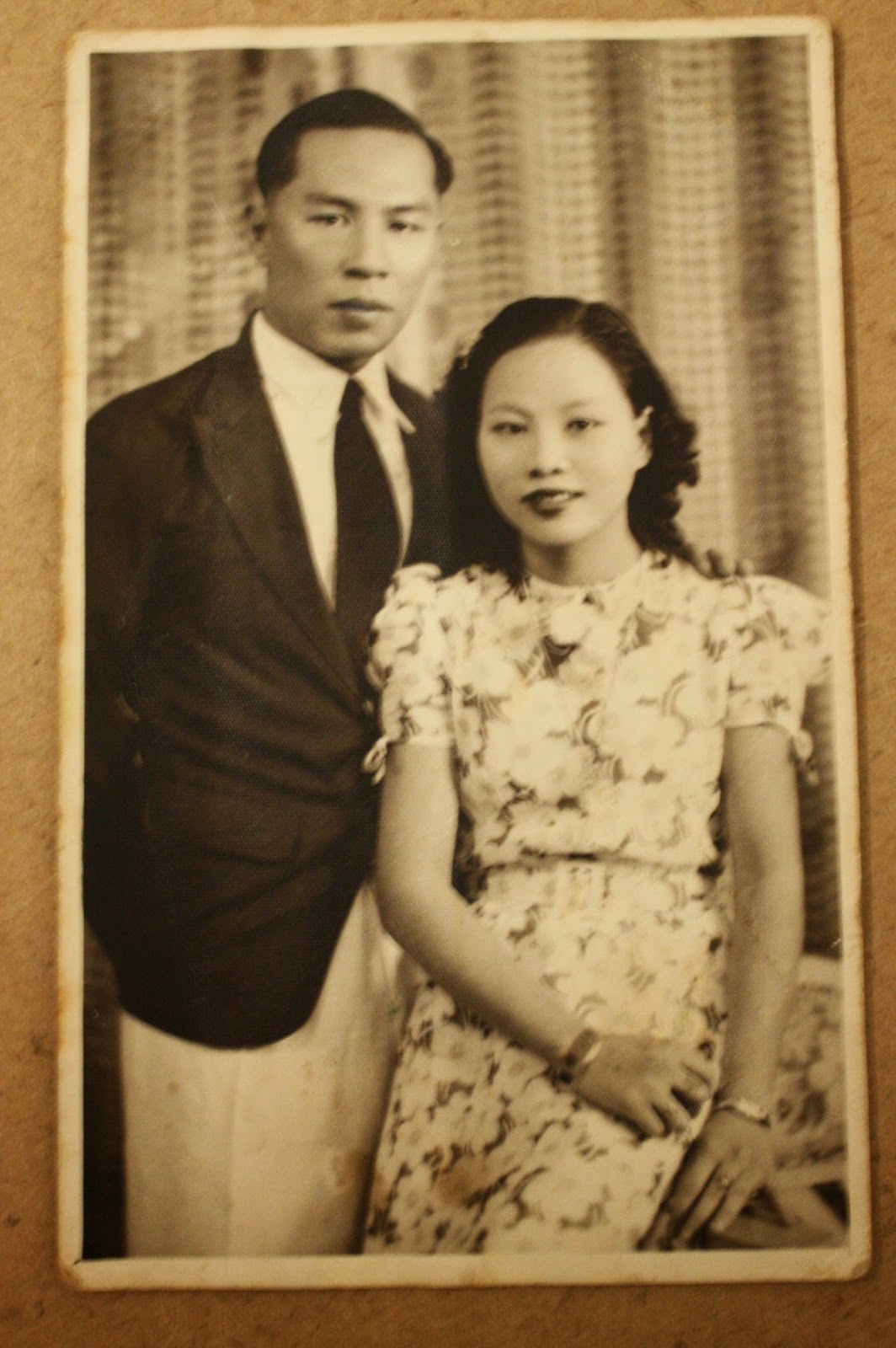
Too often memories die with their owner. Our brain cells can only remember that much, so we forget the stories our parents had told us and wish there is some form of record that we can go back to. My father left me a pen and my mother her portrait. Both of which I treasure. But how lovely it would have been if my parents had left me their memoirs.

                                                           Map of South East Asia

My father was just a teenager when he left China in the 1900 for Malaysia. I can imagine how perilous the journey at sea would have been or how hungry he was that he had to sneak into the cargo area to scavenge for anything edible. What was it like when he first felt the scorching heat and the heavy humidity on his skin when he landed in the new country he would call home for the rest of his life?


My parents

In those days marriages were arranged. What was it like for my mother to have married a man she had never met before? How did she survive living in poverty in a wooden shack in the jungle surrounded by tigers and other wild beasts? She did tell me that she saw tiger paw prints surrounding the house. Although they narrated these stories to their children, it is strange how we remember bits and pieces but never the whole. Stranger still when different children remember different bits and pieces. And there is no one to tell us if our memories are fictional or real.

At one stage or another, some of us have toyed with the idea of writing something about ourselves and getting it printed. In the meantime, we keep journal entries that are privy to our eyes alone. We even keep public and private blogs. We write articles, poems and short stories and make someone else the protagonist.

It is always safer to create a character to speak for us, to provide the voice for what we think or feel. We hide behind the security that the stories we write are based on our experiences but we are not the story per se. Another nagging worry is would anyone be interested in our lives and are we not being presumptuous that there is a whole community out there just dying to know our story? After all, we are just living everyday lives and we have neither walked on the moon nor discovered penicillin.

Maybe I would wait until I am 60 to write my memoir. Maybe I never will. But in the meantime, I would wait for Michael Harding to come to the nearest city so I could get my book autographed.


This is as good as it gets.

Source: http://www.nst.com.my/node/53320

Friday, September 10, 2010

ACTUALISING ANGELA'S ASHES


MANY of us have stories to tell but how many are able to tell them so well that they do not look like washing dirty linen in public? Memoirs that are detailed at the right places and punctuated with candour and wit are a breath of fresh
air.
W. Somerset Maugham once said that “To acquire the habit of reading is to construct for yourself a refuge from almost all the miseries of life.” Somewhere after “make a million dollars, have a make-over”, “stop p r o c r a st i n at i n g ”, and “be on time”, “read more” is one of the top goals that many people set for themselves.


The first step is to get a good book.

This can be hugely satisfying. It shows things beyond daily horizons, and characters are so vivid you feel as if you really know them. The reader and the writer may be separated from each other in time and space, yet there are links common enough to ignite the faintest connections as we recognise that we have been there and done that. The settings may be different but human folly and wisdom cut across boundaries.
The next step is to embark on a walking tour. Walking tours are good for the soul, whether leisurely or purposeful and help us truly appreciate historic neighbourhoods, buildings, and culture. They allow the unraveling of both facts and juicy bits on the side, giving them the personable touch.

Compare this with a bus tour where the driver speaks into a microphone and you use the headphones which promise to explain the necessary in a number of languages of your choice, that is, when they are not faulty. You may see a variety of sites but yet never really see what is revealed in just an hour or two as you walk the same paths as someone else did decades and centuries before you.

Historic neighbourhoods scream of sufferings, trappings and troubles as stoic determination results in ambitions realised and hopes fulfilled.
Indeed it is difficult to think about things the same way after you have beaten the same streets as real people have walked. It is like dessert after a meal. Pleasurable.

So I called Noel Curtin and enquired whether we could take a walk.


Not any ordinary walk, but a walk through the late Frank McCourt’s Angela’s Ashes, the Pulitzer Prizewinning book. I was not disappointed.
Noel fixed a Saturday where I could join ten other tourists to meander through the once squalid roads of Limerick, Ireland.

I quickly re-read the book so I would not miss out all the details that set the pulse of the memoirs and waited anxiously for Saturday to arrive only to find that the ten other tourists had made other plans. Undaunted, Noel assured me that the walk was still on.

Much to my delight, what had started out as a group walking tour became a personalised tour .

It had drizzled earlier in the morning.

As I contemplated taking an umbrella, I abandoned the idea once I realised that the rain would only make the streets of Limerick more endearing and authentic. Pervading through the book was the smell of the damp cold climate of Ireland where each child once had only one set of ragged clothes, patched shoes, and lacked a coat. Someone once said that Angela’s Ashes probably got its title from the Irish oral tradition of telling stories while stoking the ashes of the fireplace.

Noel painstakingly stopped at strategic locations featured in Angela’s Ashes: the post office where the author worked as a telegram delivery boy, Leamy school where he studied and the churches that played significant roles in his life. Even as I scribbled interesting notes, images of McCourt and his brother picking up coal dropped along Dock road vividly played in my mind.
McCourt wrote, “Mam is in a terrible state at home. There isn’t enough coal to cook the dinner, the water isn’t boiling anymore and she says she’s demented with worry.


We ’ll have to go down the Dock Road again to see if there’s any coal or turf lying around from the lorries. Surely we ’ll find something on the road this day of all days. Even the poorest of the poor don’t go out on Christmas Day picking coal off the road. There’s no use asking Dad to go because he will never stoop that low … .” It was once again life in Ireland, specifically life in Limerick city during the 1930s and 1940s in all its grittiness and grinding poverty. Going through the city streets and lanes helped relive the memoirs and I felt like a privileged intruder into another’s private world.

Sunday, September 5, 2010

RELIVING FLEET-ING MOMENTS


COMICS are a source of fun. I know that because I was an avid reader of Beano and my favourite characters were Dennis the Menace, Roger the Dodger, Minnie the Minx and The Bash Street Kids. I often wondered why after having read the 100th copy of Beano, the Bash Street Kids still remained in Class 2B and the teacher had not aged one bit.
Nothing is more powerful than the memories created by a child's experiences. Childhood is when life is uncomplicated, meaningful and straightforward when compared to adulthood where society in the persons of significant adults, model that life has meaning only when we limit ourselves to the labels of productivity, effectiveness and success.

Time has a way of breaking up our memory into little jigsaw pieces and through time we try to capture and preserve them within the confines of our mind.

So I made a bucket list of all the things I would like to do. Interspersed among the common things like travelling to exotic lands or feasting at grand hotels, there are a number of small things which are delightful to me.
One of them is standing in front of 185 Fleet Street, London with a Beano in my hand.

Just as one would associate the blue door with the famed Notting Hill movie, this particular address was where Beano was first published. While others dreamt of seeing the Eiffel Tower or Statue of Liberty, I knew I had to walk along Fleet Street.

Somehow to a child, every page of the comic running through the printing machine promised more laughter, more antics and more fun. I also imagined the rumbling machinery of the printing press, starting off slow then gathering momentum and emitting hot steam, not unlike a steam engine train.

Although Fleet Street is now associated with matters of the law, it was once synonymous with the written word. It was the home of the British press until the 1980s when it headed east to Canary Wharf and Wapping.


I could well imagine the scandals, the gossips and the exciting news exchange between journalists of that time. I could not resist trying the sticky toffee pudding that famous journalists rooted for and then entering a British red telephone box not to emerge as my alter ego (like Superman ) but to try to call my friends at the press.

If rubbing shoulders with the rich and famous is important to reach one's station in life, being physically close to where the famous journalist, the poor playwright or the humble novelist of the past is important to fulfil one's sense of personal achievement. Thus, I sauntered into Ye Olde Cheshire Cheese, which true to its name, had a gloomy charm.


Charles Dickens, who frequented the tavern, even alluded to it in A Tale of Two Cities where the character Charles Darnay had "a good plain dinner and wine at a tavern on Fleet Street".

I chose a chair just next to where Charles Dickens would have sat. There was a plaque bearing his name, thus reassuring me that I was at the correct seat.


It has often been said that we live on a sparse diet of promises we make to ourselves when all the conditions are perfect. Perfect conditions may not happen and life has a way of accelerating as we get older.

I have seen so many senior people, despite having weak knees and bad feet, still actively climbing up and down tourist destinations. They seem to tell me that the best way to get the most out of life is to look upon it as a magnificent adventure.

I gaze at the remaining eight items on my bucket list and I could not agree more.

Sunday, August 8, 2010

LOOKING FOR LEFROY

I lingered outside a huge iron gate on 18 July 2010 hoping to catch someone friendly enough to answer my curiosity because I was informed that the house within was no ordinary house as the owner is a Lefroy. Just as the name Kennedy would bear associations to U.S. presidency, to an English literature enthusiast, the name Lefroy could be the Lefroy that Mr.Darcy was probably modelled after in Jane Austen’s Pride and Prejudice.

Let me explain.

Jane Austen died on 18 July 1817 and Mr. Darcy the novel’s hero, made famous by Colin Firth in the 1995 adaptation of Pride and Prejudice is the man that most ladies would die for. Word has it that one of the likely candidates of real life Mr. Darcy was Tom Lefroy, a 20 year old Irish who visited Jane at her Hampshire home of Steventon in mid December 1795 on her 20th birthday.

Unlike Elizabeth Bennet, the heroine of the novel who finally tied the knot with Mr.Darcy, Jane Austen remained single throughout her life, despite being called on by potential suitors. It was a question of being successful and risking it all. Tom Lefroy was expected to ‘rise into distinction and there haul up the rest’ but he could risk all of it if he married Jane who had no money. Tom who chose the former went on to build a massive Gothic mansion Carrigglas Manor for his family in County Longford. The grey turreted house has recently been renovated into a hotel with a rambling 660-acre golf course and housing estate. Interestingly enough, Tom called his first daughter Jane after marrying Mary Paul in 1799. This private segment of Austen’s life was portrayed in the 2007 biographical portrait ‘Becoming Jane, directed by Julian Jarrold with Anne Hathaway acting as Jane.

Jane Austen said, "A woman especially if she has the misfortune of knowing anything, should conceal it as well as she can."

When we compare the station of a young person then and now, we have indeed come a long way. The good and the bad. When before young girls could only dream of going to school and cash and status conscious parents kept women from the men of their dreams, now we have opportunities to succeed and the liberty to live. It was also not uncommon then for young men to leave school to fend for the family and take on more jobs than one. They were determined, focussed and industrious. They took pride in the toil of their labour, so to speak.

But now, we have survival guides on how to cheat the welfare state.

I have been here for a fortnight and I have met more than five young educated people who prefer to depend on the state for their daily sustenance and hang around pubs smoking, drinking and idlying. Psychologically, they are convinced that state benefits are not charity handouts but they are their rights. They still live with their parents and their parents still pick up after them. They take on part time rather take full time jobs. I even heard one grumbling that working from 3p.m. to 9 p.m. at a part time job had destroyed his social life.

I watched a cartoon once where a group of graduating students queued to receive their scrolls from the college president. After having received their scrolls and tossing their mortar boards into the air, they made a bee line to another queue, this time the dole queue. I was eight then and did not understand one bit what it was all about.

According to a Leicester Mercury report early this year, Leicestershire's dole queue has seen its biggest increase in 11 months after soaring by more than 1,000. The number of Jobseekers' Allowance claimants in the city and county rose by 4.3% to 24,607 in January. Northern Ireland has been hit harder by the economic crisis than any other UK region. New figures show that six towns in the province are in the top 10 UK dole blackspots based on regional increases in claimants.

I was brought up in a generation where living off the state would be a huge embarrassment and a disaster. We all had to try different types of work while deciding on a long-term career plan. In fact, while we were yet students we did part time jobs during the holidays. I knew someone who worked at his parents’ food stall after school and yet he rose to become a successful dentist. I knew of another who gave all the prize money he received from the university to his parents to help run the household.

As in every scenario there are genuine cases of hardworking people being laid off. But then again, there are plenty of loafers. It is every working class parent’s dream to see a child graduate and get a job, move out of the family home by 25, own a house by 30 with some savings on the side for marriage and set up a new home. It represents upward social and financial mobility. Now, we sincerely rejoice with the parents who have responsible grown up children and lament in silence if ours are not the same.

That brings me back to the industrious Lefroy who being the first son among 12 siblings probably gave up personal happiness to help better the status of his family. So as I reluctantly walked away from the huge iron gate, I told myself I must call another day just to confirm my suspicions that the real descendents of Tom Lefroy are in my neighbourhood. I live in hope still.